How Estate Agents Can Prioritise What Really Matters
When everything feels urgent, estate agency owners can end up reacting all day and leading very little. The Eisenhower Matrix helps you separate what needs your attention now from what should be scheduled, delegated or removed completely.

The list never ends when you own the business
There is always another thing.
Another system to integrate. Another campaign to build. Another valuation to prepare for. Another member of staff who needs support. Another landlord question. Another compliance update. Another sales progression issue. Another Meta ad you think you should probably launch. Another branding conversation you have been meaning to start for months.
Most estate agency owners are not short of work. They are drowning in the amount of work that appears to matter. That is where the pressure builds. Not from one big decision, but from the weight of a hundred open loops. You start the day thinking you are going to move the business forward, then you spend most of it reacting to whatever arrived loudest. By the end of the week, you have been busy. You may even have been productive. But the bigger question still sits there.
Did you lead the business, or did you just survive the list?
Busy can become a hiding place. There is a particular trap in estate agency because the business gives you endless reasons to stay reactive. Clients need answers. Deals need saving. Staff need direction. Marketing needs doing. The phone rings. The inbox fills. The market changes. A competitor does something that makes you question whether you should be doing it too. So the owner keeps moving.
The danger is that movement starts to feel like leadership, it is not.
Leadership is not doing more things. It is deciding which things deserve your best attention, which things need a proper place in the calendar, which things somebody else should own and which things should stop taking oxygen from the business.
This is where the Eisenhower Matrix becomes useful. It is a simple decision making framework that helps you separate tasks by urgency and importance. In plain terms, it asks four questions.
What needs doing now?
What needs scheduling?
What needs delegating?
What needs eliminating?
For an estate agency owner, those four questions can change the whole movement of the business.
A tasks need action now
A tasks are urgent and important. These are the things that require your immediate attention because there is real consequence if they are ignored. They are not just loud. They matter. In an agency, an A task might be stopping wasted ad spend that is clearly not converting and is damaging cash flow. It might be dealing with a major client complaint before trust collapses. It might be stepping into a fall through risk on a high value sale where timing, communication and judgement are critical.
It could be addressing a team issue that is affecting performance today. It could be a compliance problem that cannot wait. It could be a pipeline gap that needs immediate leadership because the next ninety days are exposed. The key is not to label every urgent interruption as an A task. That is how owners lose control.
An A task should pass a simple test. If this is not dealt with quickly, will it create a serious commercial, operational, legal, reputational or human cost?
If the answer is yes, it needs your attention.
If the answer is no, it may simply be noise wearing urgent clothing.
B tasks need a place in the diary
B tasks are important, but not urgent. This is where much of the real business building sits. Brand strategy. System reviews. Team training. Leadership development. December planning meetings. Reviewing the client journey. Improving the valuation process. Mapping next year’s marketing. Creating a stronger landlord proposition. Building a better database strategy. Looking at where AI, automation or new technology can support the business properly. These tasks often get pushed back because they do not scream but they are usually the work that prevents future pressure.
A B task might be scheduling a proper meeting in December to review the agency’s brand, not just colours and logos, but what the business actually means to the client. It might be booking time to assess whether your marketing spend is aligned with your strategy. It might be setting aside half a day to review your fee position, your sales pipeline and your operational structure before the next year begins.
This is the category many owners neglect.
Not because they do not care. Because the urgent work keeps stealing from the important work.
If you never schedule the B tasks, your business will eventually create more A tasks.
C tasks should not always be yours
C tasks are urgent but not important enough for the owner to complete personally. They still need doing. They may even need doing quickly. But they do not need to sit with you. This is where delegation matters.
A C task might be chasing appointment confirmations, uploading content, checking advert links, arranging keys, sending routine emails, preparing basic reports, updating spreadsheets, organising meeting notes or handling administrative follow up. In a smaller agency, delegation can feel difficult because everyone is already busy. But the question is not whether delegation is convenient. The question is whether the owner’s attention is being used at the right level.
If you are the person holding every small urgent task, you become the ceiling of the business. Delegation does not mean dumping work on people without context. It means creating ownership, standards and trust so the business can move without everything returning to you. A founder led agency cannot become more strategic while the founder is still personally carrying work that should have been systemised, trained or handed over.
D tasks need to disappear
D tasks are neither urgent nor important and they should be eliminated. This is the hardest category for many owners because D tasks often feel harmless. A quick scroll. A pointless meeting. Another platform to look at. Another competitor check. Another idea that sounds interesting but does not serve the strategy. Another conversation that goes nowhere. Another task done out of habit because nobody has questioned it.
In estate agency, D tasks can also include marketing activity that exists only because someone said you should be doing it. Posting without purpose. Running ads without understanding the numbers. Creating content that does not strengthen the brand. Keeping reports nobody reads. Attending events that do not align with the business. Holding meetings with no decisions attached. D tasks are dangerous because they rarely look damaging in isolation but together, they steal capacity from the work that would actually move the business.
Elimination is not laziness. It is leadership protecting focus.
If you run a small or medium sized estate agency, your attention is one of the most valuable assets in the business. You do not have unlimited people, time or budget. That means every misplaced hour has a cost. Every unclear priority creates drag. Every task sitting in your head becomes another reason the business depends too heavily on you. This is not about building a perfect productivity system. It is about creating a clearer relationship with the work. When you know what is A, you act faster. When you know what is B, you schedule it before it becomes urgent. When you know what is C, you stop pretending everything needs your fingerprints on it. When you know what is D, you give yourself permission to remove it. That is how an owner moves from reacting to leading.
A simple way to use it this week
Take your current task list and put every item into one of four categories.
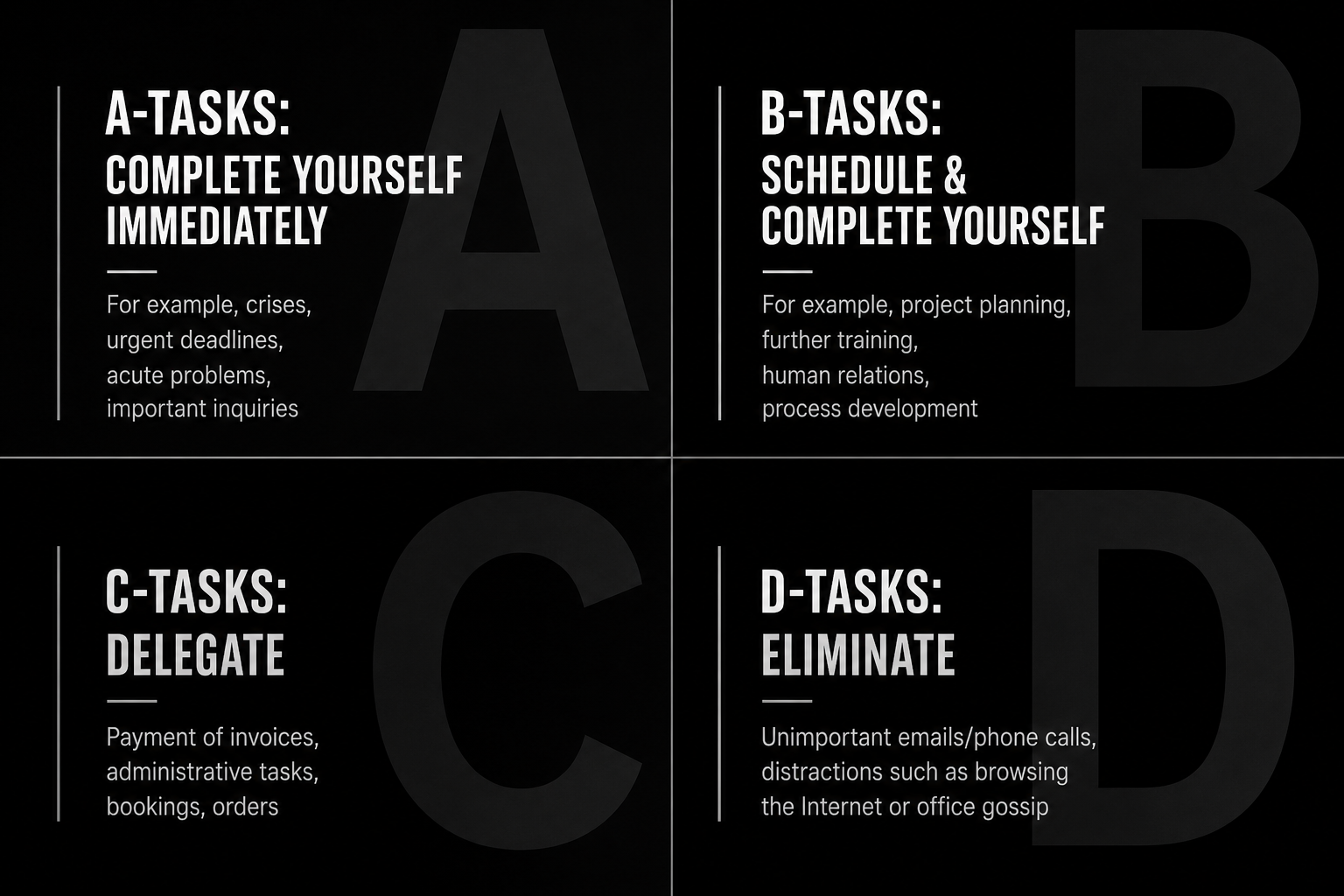
A tasks: Complete yourself immediately because the consequence of delay is real.
B tasks: Schedule properly because they are important to the future of the business.
C tasks: Delegate because they need doing, but not by you.
D tasks: Eliminate because they are not serving the business enough to justify the attention.
Then be honest about what you find. If everything is in A, you are probably confusing urgency with importance. If nothing is in B, you are neglecting the future. If nothing is in C, you may be holding too much. If nothing is in D, you are almost certainly tolerating waste.
Write down the ten things currently taking up the most space in your head.
Do not organise them yet. Just get them out.
Then mark each one A, B, C or D.
Do one A task today. Put one B task in the diary. Hand one C task to someone else with clear expectations. Remove one D task completely.
That is where control starts to come back.
You do not need a shorter list. You need a clearer one.