
How Physical Discipline Builds Mental Resilience in Estate Agency
Long term leadership in estate agency depends on sustained clarity, emotional regulation, and decision quality. This article explores the research-backed link between physical discipline, cognitive resilience, and leadership longevity, and why owners who ignore it quietly pay the price over time.
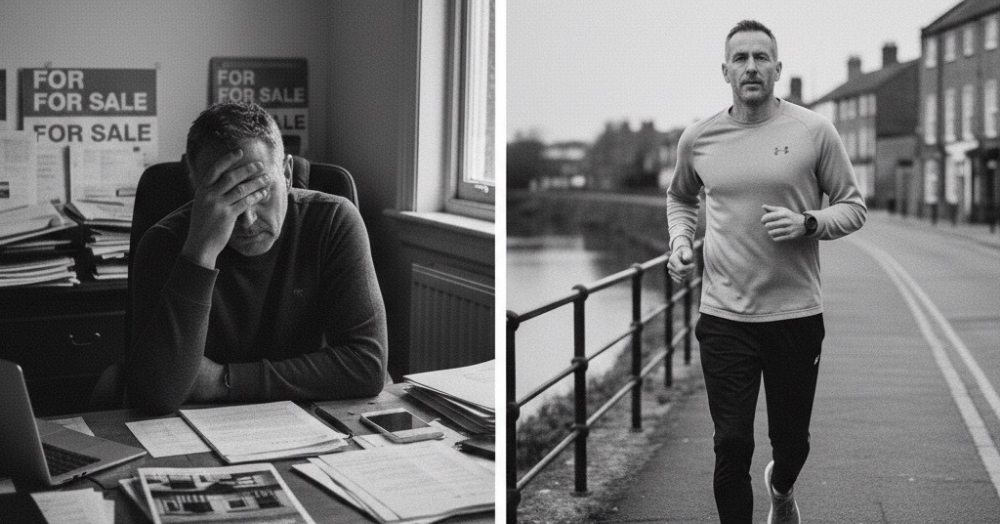
Estate agency ownership rarely breaks people in obvious ways. More often, it wears them down gradually through constant cognitive demand, emotional exposure and the unrelenting need to make decisions that carry financial and human consequences.
Every pricing conversation, staffing issue, negotiation, complaint, or strategic call draws from the same mental reserve. When that reserve is not replenished or strengthened, leaders do not suddenly fail. Instead, clarity dulls, patience shortens, and decisions become increasingly reactive rather than intentional.
This is not a discipline problem. It is a capacity problem.
Research in behavioural psychology, including work popularised by Roy Baumeister and later supported by neuroscientific studies, shows that decision making is a finite cognitive resource. As decision load increases, the brain defaults to shortcuts, avoidance, or emotionally driven responses.
For estate agency owners, this explains familiar patterns. Avoiding difficult conversations, over delegating critical decisions, reacting defensively in negotiations and chasing short term certainty instead of long term positioning.
Crucially, these patterns are amplified under chronic stress.
Physical discipline has been shown to mitigate this effect. Studies published in Frontiers in Psychology demonstrate that regular exercise improves executive function, working memory, and cognitive flexibility, all of which are essential for sustained leadership performance. In simple terms, physically conditioned leaders retain decision quality for longer periods under pressure.
Leadership resilience is often framed as mindset or grit. While these play a role, research from Harvard Medical School and Stanford University consistently shows that emotional regulation depends heavily on the balance of the autonomic nervous system.
Regular physical activity strengthens parasympathetic response, improving the body’s ability to return to baseline after stress. This is why leaders who train consistently tend to recover faster from conflict, pressure, or disappointment.
In estate agency, where emotional volatility is part of the environment, this matters deeply. An owner who can regulate themselves creates stability. An owner who cannot unintentionally exports stress into the business.
Consider a leader facing a sustained period of market uncertainty, with stock levels tighten, fee conversations become harder and team morale wobbles.
One response is constant urgency. More meetings. More pressure. More reaction.
Another response is steadiness, clear communication, fewer but better decisions and calm leadership presence even when outcomes are uncertain.
The difference is rarely intelligence or experience. It is physiological readiness.
Owners who maintain physical discipline consistently report greater emotional bandwidth in these moments. They are less threatened by resistance, more willing to hold long term standards, and better able to separate signal from noise.
Cognitive science tells us that insight often occurs when the brain is not actively forcing solutions. Movement supports this process by reducing cognitive load and allowing information to integrate naturally. This is why many leaders experience clearer thinking during walks, training sessions, or physical routines than during prolonged desk time.
For estate agency owners, this means some of the most important strategic decisions should not be made under static pressure, but after movement has restored perspective.
The mistake many leaders make is treating fitness as optional self improvement rather than leadership infrastructure. Sustainable owners approach it differently.
They prioritise consistency over intensity, ensuring movement survives busy periods rather than disappearing when pressure increases. They schedule physical discipline with the same seriousness as financial reviews or leadership meetings. They also use physical challenge as feedback, noticing how they respond to discomfort, resistance, or fatigue, and reflecting on how those responses mirror leadership behaviour.
This creates self awareness that no performance review can replicate.
Leadership behaviour compounds. Over time, teams mirror the emotional tone set at the top.
A regulated owner reduces background anxiety.
A clear owner simplifies decision making.
A resilient owner builds a business that does not rely on constant urgency to perform.
This is how long term standards are set, not through slogans, but through behaviour that is repeatable and sustainable.
Choose one form of physical discipline you can maintain consistently over the next ninety days and formally integrate it into your leadership schedule, treating it as maintenance for decision quality rather than optional wellbeing.
Longevity in leadership is not about pushing harder.
It is about building the capacity to lead well for longer.