How the Change Kaleidoscope Helps You Lead
Strategic change rarely fails because the idea was wrong. It fails because leaders try to introduce it without understanding the people, pressures and patterns already shaping how their estate agency really works.

The business you want to build is not always the business you are leading today
Most estate agency owners can see what needs to change before the team can. They can feel when the current structure is no longer enough. They know the brand needs more depth, the systems need more consistency, the team needs stronger leadership or the business has become too dependent on them personally. They can see the gap between where the agency is today and where it needs to be in 3, 5 or 10 years.
But seeing the future does not automatically mean the business is ready to move towards it.
That is where many change programmes begin to lose momentum. The owner has clarity. The plan makes sense. The ambition is real. Yet the people, systems, culture and internal pressures around the business are still arranged in a way that makes change harder than it first appears.
The issue is not always the strategy. Sometimes it is the context surrounding it.
Why the Change Kaleidoscope matters
The Change Kaleidoscope is a framework for identifying the key features that need to be taken into account when designing a change programme. The name is useful because it explains the point as its like a toy kaleidoscope containing the same collection of pieces every time you look through it. Turn it slightly and those pieces rearrange into a completely different pattern. Nothing new has been added. Nothing has disappeared. But the relationship between the elements has changed, and the overall picture looks completely different.
An estate agency works in much the same way.
Most businesses have people, systems, resources, power, culture, history, capability and pressure but those elements never sit in exactly the same place from one agency to the next. The same change can therefore feel exciting in one business, threatening in another and almost impossible in a third.
A self employed agent changing their positioning has a very different context to a single branch agency with a long standing team. A multi branch business with experienced managers has a different context again to an owner led agency where every decision still returns to one person.
The Change Kaleidoscope helps you look at those conditions before you decide how to lead the change.
It does not tell you what your strategy should be. It helps you understand what kind of change programme your business can realistically support.
Take something as simple as raising fees.
For one agency, this might be a relatively straightforward change. The brand is strong, the team believes in the service, the marketing is consistent and the owner is already clear about the value being delivered. The work may be mostly around sharpening language, reinforcing confidence and holding the standard.
For another agency, raising fees may expose much bigger issues.
The valuation team may lack confidence. The marketing may not support the proposition. The client experience may be inconsistent. The owner may still step in and discount when pressure appears. The team may not understand what genuinely makes the agency different from the competitor down the road.
The desired outcome is the same. The change context is not.
That is why copying somebody else’s plan rarely creates the same result.
The eight things every owner needs to examine
The Change Kaleidoscope centres on eight contextual areas.
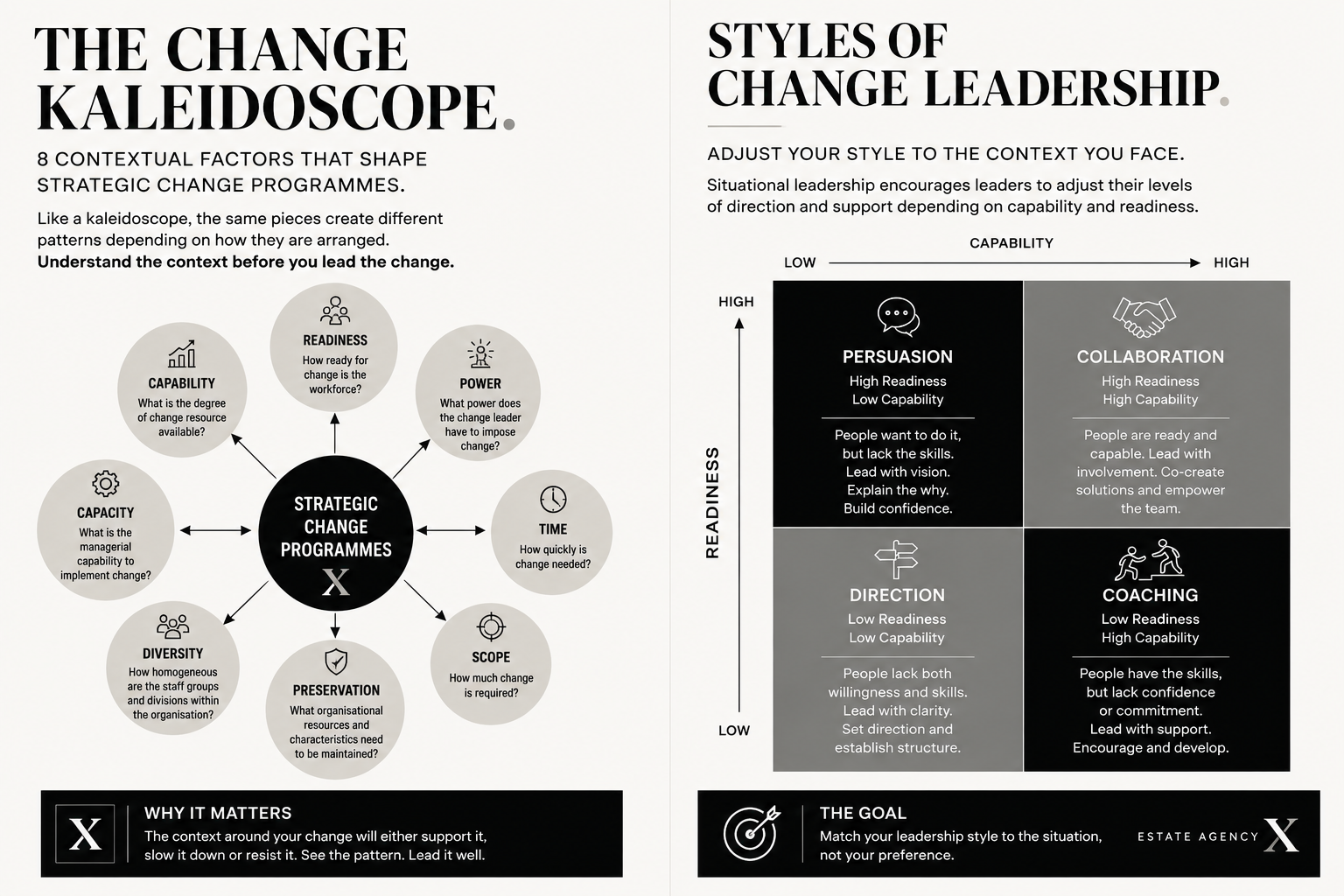
Time asks how quickly the change is needed. Some agencies can take twelve months to build capability, test ideas and bring people with them. Others are already under pressure. Their fees are weakening, their systems are failing, key people are leaving or the owner is becoming the bottleneck. The urgency should influence the pace.
Scope asks how much of the business needs to change. Is this a new process, or are you asking the agency to rethink its brand, systems, leadership, commercial model and client experience all at once? The wider the scope, the more intentional the implementation needs to be.
Preservation asks what should be protected. Change should not casually destroy the things that made the agency successful in the first place. Local trust, client relationships, a reputation for care and strong team values may all need preserving, even while the business modernises.
Diversity asks how similar or different the groups inside the business are. A negotiator, a valuer, an administrator and a branch manager may all hear the same announcement but experience it very differently. The more varied the organisation, the less likely one message will land equally with everyone.
Capability asks whether the management team can actually lead the change. Can they communicate clearly, deal with resistance, support people through uncertainty and hold standards while the business continues to trade? A change programme cannot live only in the owner’s head.
Capacity asks what resources are available. This is not just money. It is time, energy, skills, training, focus and emotional headroom. Many businesses want transformation while their people are already stretched managing valuations, viewings, sales progression and client demands. That is not always resistance. Sometimes it is simply exhaustion.
Readiness asks whether the workforce is prepared for the change. Do they understand why it matters? Do they trust the leadership? Have they seen too many initiatives arrive with noise and disappear without follow through? Readiness is not something you demand. It is something you build.
Power asks how much authority the change leader really has. The owner may have formal authority, but informal influence often sits elsewhere. A long serving manager, respected valuer or key operations person can either create momentum or quietly reinforce the old way of working.
The real value is not in filling in the framework
The danger with any framework is turning it into another exercise that looks useful on paper but changes nothing in practice.
The point of the Change Kaleidoscope is not to fill in eight boxes and congratulate yourself for being strategic. The point is to see what may be helping or resisting the change before those issues become problems.
It helps you recognise that a lack of readiness may need more communication. A lack of capability may need development. A lack of capacity may mean narrowing the scope. A powerful person who is not aligned may need to be involved earlier. A valuable part of the business may need preserving rather than replacing.
This is where the Force Field Analysis becomes useful too.
The Kaleidoscope helps you understand the wider context. Force Field Analysis helps you identify the specific forces that may either block or facilitate the change you are trying to make.
Force Field Analysis compares the forces at work within an organisation that may either block or facilitate change. It helps leaders move beyond assuming resistance is simply negativity, and instead understand what is making progress difficult, what is already helping, and what needs to be strengthened.
When looking at a proposed change, ask:
What aspects of the current situation could block change, and how can those blocks be overcome?
What aspects of the current situation may facilitate change in the desired direction, and how can they be reinforced?
What needs to be introduced or developed to add strength to the forces for change?
For an estate agency, this could mean identifying whether outdated habits, limited confidence, lack of time, unclear leadership or weak systems are holding a new strategy back. It could also reveal the things already working in your favour, such as a trusted team member, strong client feedback, a clearer proposition or a growing appetite for change.
The point is not to force the business forward harder.
It is to reduce the friction, reinforce the momentum and build what the change needs to succeed.
One framework helps you see the pattern. The other helps you shift it.
Before you announce the next major change in your agency, take a step back.
Look at the business through the eight elements of the Change Kaleidoscope. Be honest about the agency you have today, not the version you are hoping to build tomorrow.
Then ask yourself whether your plan is designed around the real context of the business or simply around the speed at which you want the change to happen because the strongest leaders do not force change through a business.
They understand the pattern first, then lead it somewhere better.