Strategic Drift In Estate Agency Is Quietly Costing You
Strategic drift happens when your agency keeps doing what once worked while the market, the client and the standard keep moving. For estate agents, it rarely looks dramatic at first, but left unchecked, it weakens fees, relevance, team performance and future business value.

The danger rarely arrives all at once
Most estate agencies do not lose relevance because of one catastrophic decision. They lose relevance through a series of smaller decisions that felt reasonable at the time. The same systems kept working well enough, the same marketing still brought in some leads, the same valuation approach still won enough instructions, and the same way of leading the team still felt familiar. From the inside, it can feel like stability. From the outside, it can look like a business slowly becoming less aligned with the world around it.
That is what makes strategic drift so dangerous. It is rarely obvious in the moment. It does not always feel like failure while it is happening. It can feel like staying sensible, protecting what built the business, or not overcomplicating something that still appears to function. But the market does not stop evolving because an owner is tired, busy or emotionally attached to the model that once made them successful.
You can still be working hard and be drifting at the same time.
Strategic drift is the point where the environment around a business changes faster than the business itself. There is first a period of incremental change, then strategic drift, then flux, and eventually a point where the organisation faces transformational change or decline.
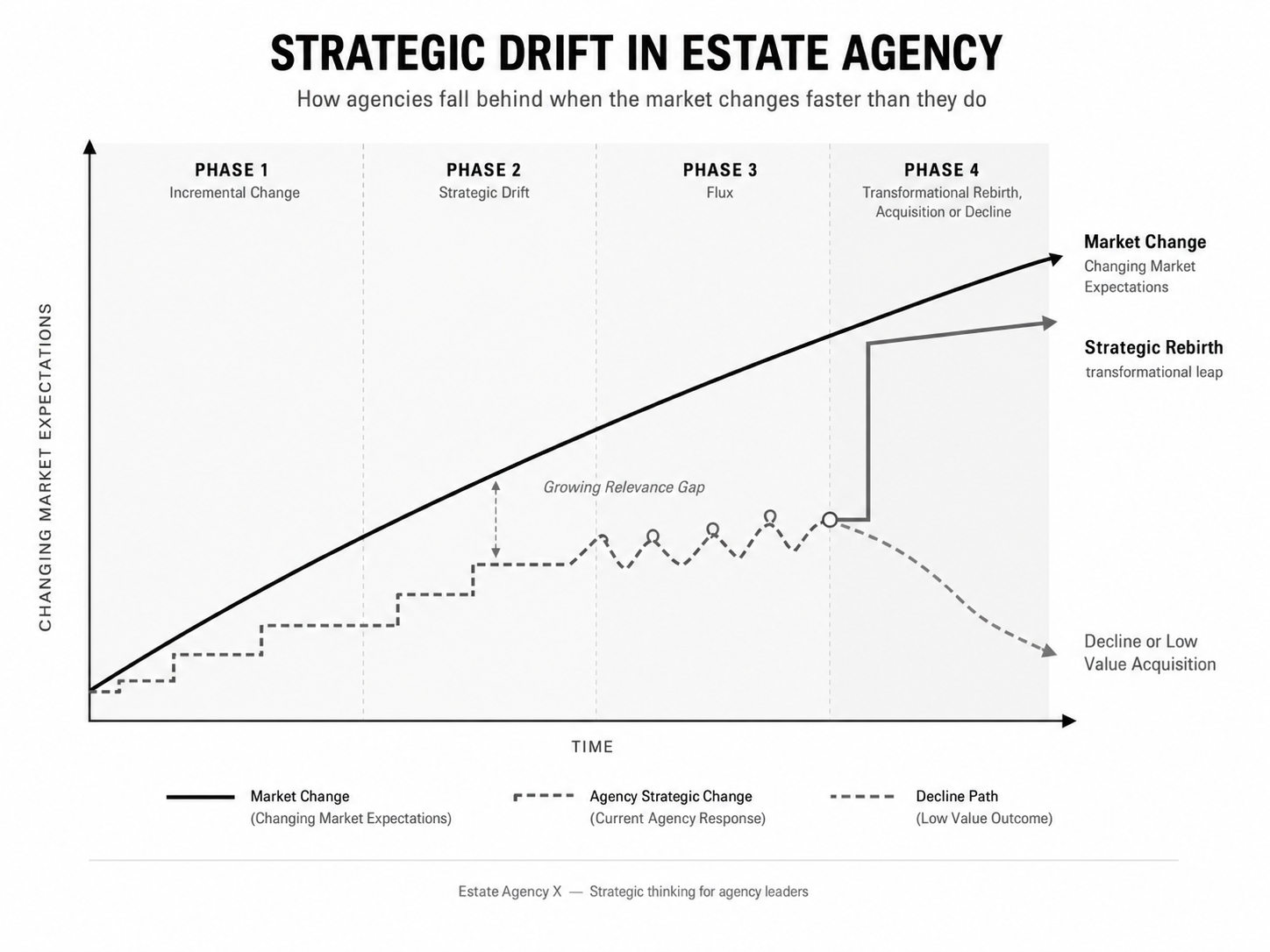
That matters in estate agency because the market is not only changing in terms of prices, stock levels or interest rates. The real shift is in how the public chooses agents, how trust is built, how technology shapes attention, how teams expect to be led, how operations need to run, and how easily a weak proposition gets compared with someone cheaper.
A basic PESTLE analysis makes this obvious. Technology is changing the way people search, compare and decide. Social expectations are changing the way clients build trust before they ever invite you into their home. Legal and compliance pressure requires stronger systems. Human behaviour inside teams is shifting too, because people no longer want to work inside businesses that run purely on personality, pressure and habit.
If your agency is still built around assumptions from five, ten or twenty years ago, then your issue may not be effort. Your issue may be misalignment.
The three routes agencies tend to take
When the market changes, estate agencies usually take one of three routes. The first is to move ahead of the market. These are the businesses that think entrepreneurially, invest early, sharpen their proposition, improve their systems, strengthen leadership and keep building before they are forced to.
The second route is to move with the market. These agencies may not always be the innovators, but they remain aware enough to keep adapting. They review their brand, their fee story, their systems, their marketing, their team capability and the client experience regularly enough to stay relevant.
The third route is strategic drift. This is where the business keeps making small, familiar changes while the market is moving more significantly. The owner may still be grafting, the team may still be busy. Instructions may still be coming in but the business is no longer evolving at the pace required to remain sharp, differentiated and valuable.
Strategic drift is not about standing still. It is about changing too slowly for the environment you are now in.
In estate agency, drift often hides inside things people excuse too easily. It shows up when the owner is still the main system, the main decision maker, the main problem solver and the main standard bearer. It shows up when the lettings book is carrying the financial load, but the wider business has no clear growth engine, no distinctive brand and no operational strength beyond the founder’s effort.
It shows up when the team is busy but not genuinely high performing. It shows up when the brand still leans on words like trusted, experienced and local, but cannot clearly explain why someone should pay a stronger fee. It shows up when the marketing still feels like posting rather than positioning, and when the agency has no real intellectual property, no strong internal process and no clear proposition that can stand on its own.
You also see it when owners know change is needed, but keep circling around surface fixes. A new logo. A slightly better website. A new system nobody properly adopts. A few social posts. A nicer brochure. Those things are not always wrong, but they do not solve strategic drift if the deeper business model has already fallen behind.
Kodak is the warning, but it is not the lesson
Kodak is often used in strategic drift discussions because it saw technological change coming but failed to reshape the business quickly enough around that change. The issue was not a lack of awareness, it was a lack of timely transformation.
That is why the example matters for estate agents. Most agency owners are not blind, they know marketing has changed, technology is changing, the team needs more structure and the client wants more confidence, more clarity and more proof. They know the business cannot rely on habit forever.
But knowing is not the same as moving.
That is where drift becomes commercial. If the gap keeps growing between what the market now values and what your agency is still set up to deliver, then eventually that misalignment shows up in fee pressure, recruitment problems, slower growth, weaker margins and lower long term business value.
If drift continues long enough, the business usually arrives at one of three outcomes. The first is decline. The agency keeps going, but with less energy, less relevance, lower confidence and more pressure on the owner. The second is acquisition, but often at a lower value than the owner hoped, because the business has not built enough beyond a lettings book, a local name and the founder’s personal effort. The third is transformational rebirth.
That rebirth is not cosmetic. It is not a case of repainting the walls and rewriting the homepage. It means going back to the foundations of the business and asking what this agency now needs to become in order to stay relevant, profitable and desirable in the next version of the market.
This is also why strategic drift is not just a marketing issue. It affects succession, exit value and whether the owner can step back. It affects whether the team can perform without constant rescue and if the brand means anything beyond familiarity.
Real rebirth means asking tougher questions. What is the feeling behind the brand? What is the one year, three year and ten year vision? What are the internal and external systems like? How is the agency pitching value and defending fees? What genuinely makes the business different? What blind spots has the owner been tolerating? What does marketing mean now, rather than what it meant when the business first found traction?
That is why strategic drift is rarely solved by one isolated change. It usually needs a more joined up reset across leadership, operations, performance, positioning and commercial clarity. This is the kind of work we explore inside the EAX Business Accelerator, where agency owners step back from the day to day and look properly at how the whole business is built, rather than only trying to patch the symptom in front of them.
That matters because the businesses that recover best are not the ones that make the loudest changes. They are the ones that make the clearest ones.
If you are leading an agency today, the value of understanding strategic drift is simple. It helps you catch the problem before it becomes a rescue mission as you see whether your business is leading the market, moving with it, or quietly falling behind it. It helps you identify whether your current frustrations are tactical or structural. It helps you stop blaming the market for issues that are actually coming from misalignment inside the business.
Most importantly, it helps you understand that the cost of delay is not neutral. The longer the drift continues, the harder and more expensive the correction becomes.
Take one hour over the next week and audit your agency against the market you are actually in now, not the market that first made your business work. Look at your brand, systems, leadership structure, team capability, technology, client experience, fee confidence and proof of differentiation. Then ask the hardest question honestly: are we leading, adapting, or drifting?
If the answer is drifting, do not soften it. Name it, then start the correction and reach out to us in how we can support you correct it.
Move before the market moves on without you.