
The Four Strategy Lenses Every Estate Agent Needs
Most estate agents do not need more noise. They need clearer strategy, stronger choices, and the courage to build an agency that reflects who they are.
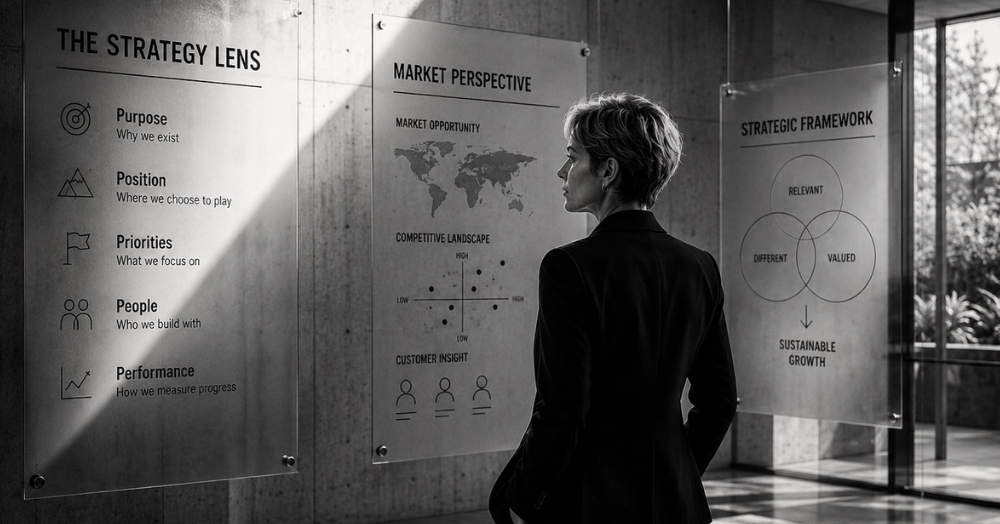
Most estate agency owners are not short of ideas. They are short of strategic clarity. That is the real issue. Ideas create movement but strategy creates direction. Ideas fill whiteboards, meetings and late night notes on your phone. Strategy asks whether the business is actually going somewhere worth reaching.
The question is not simply, “What should we do next?” The better question is, where are we actually going? Not just this month or this quarter. Not just towards more listings, more valuations, more boards or more visibility. Where are you going as a business, and does your agency currently behave like the business you say you want to become?
That is where most agencies get exposed. The market rewards activity, it ewards the visible, the loud and the constantly available but movement is not the same as momentum. Sometimes more is just noise wearing a good suit.
Strategy, in its simplest form, is the long term direction of an organisation. For an estate agency, that means knowing what you are building, who you are building it for, what standards you will protect and what you are no longer willing to chase. It is not a slogan, a quarterly target or a motivational line on the office wall. It is the direction your business proves through its decisions, habits and behaviour.
This matters because too many estate agencies are not being led with intention. They are being pulled by competitors, market conditions, portals, fee pressure, difficult clients, staff issues and the fear of falling behind. When a business is constantly pulled, it starts to lose its shape. It stops choosing. It starts copying. It stops leading. It starts reacting.
You cannot build a distinctive estate agency while reacting to everyone else.
A useful strategy framework looks at three areas. First, your strategic position, which means where the business is starting from. Second, your strategic choices, which means the options available to you. Third, strategy in action, which means how those choices are actually implemented through people, systems, leadership and change.
That sounds simple. It is not. Most estate agency owners want to jump straight into action. A new campaign. A new CRM. A new hire. A new office. A new content plan. A new valuation script. A new brand refresh. Action feels productive because it gives the business something to do but action without position is guesswork, and guesswork gets expensive.
Before you decide what to do next, you need to face where you really are. Not where your ego says you are, where your marketing says you are or where your best month made you feel you were. Where you actually are.
What is your real market position? What are clients really choosing you for? What are they not choosing you for? What are you known for when you are not in the room? What does your team repeat without being asked? What standards are protected when things get hard, and what standards disappear under pressure?
Because that is the truth. Your real strategy is revealed under pressure.
This is where leadership becomes uncomfortable. Many agency owners say they want to be premium but still behave like they are trying to win everyone. They say they want better fees but their language apologises for price. They say they want a stronger culture but tolerate people who damage the room. They say they want trust but market like they are desperate for attention. They say they want to lead differently but copy the same tired industry patterns.
That is not just a branding problem, it is a strategy problem.
Estate Agency X exists for the owners who feel this tension. The ones who know estate agency can be better. The ones who have outgrown the traditional model and want to build through credibility, belonging and sharper thinking rather than noise. The brand is built on the belief that the sharpest leaders do not need to be loud. They need to be sure.
So here is the framework.
Lens One: Design
The design lens is the planning lens. It looks at the numbers, the market, the fee structure, the pipeline, the team capacity, the lead sources, the cost base and the client profile. It asks whether the agency is built around clear commercial thinking or just running on habit.
For an estate agency owner, this lens asks: where are we strongest, where are we weakest, which clients create the most value, which activities drain energy, and which parts of the business look busy but do not build anything meaningful?
This lens gives discipline. It helps you stop confusing effort with progress but it cannot be the only lens, because a spreadsheet can show what is happening but it cannot always explain why people trust you, follow you, avoid you, leave you or choose someone else.
Lens Two: Experience
The experience lens looks at how the past shapes the present. This is powerful in estate agency because owners and teams carry history. A lost valuation. A bad hire. A failed branch. A brutal market. A client who knocked your confidence. A period where volume saved the business but quietly lowered the standard.
Experience can become wisdom but it can also become a cage. The strategy lenses framework warns that people often interpret decisions through what they have already lived, even when the market in front of them has changed.
This lens asks a brave question. Are we choosing this because it is right, or because it is familiar?
If you are still pricing based on old fear, still recruiting based on old wounds, still marketing based on old approval, or still leading based on old survival, then your past is not informing the strategy. It is running it.
What once protected you can quietly start limiting you.
Lens Three: Variety
The variety lens is about fresh thinking. It reminds leaders that strategy does not only come from the top. New ideas often come from the edges, newer people, clients and conversations outside the industry, other sectors and those who are not yet trained to accept the usual excuses.
Estate agency needs this lens badly because the industry can become painfully repetitive. Same promises, same posts, same claims about service, same valuation language and same obsession with what every other agent is doing.
The variety lens asks you to widen the room. Who are you listening to? Where are your freshest ideas coming from? What would you try if you were not trying to look like a normal estate agency?
Difference rarely comes from copying the centre.
Lens Four: Language
The discourse lens is the language lens, and this one should make every estate agent pause. Our industry is full of words that have lost their weight. Premium. Bespoke. Trusted. Local expert. Personal service. Client focused. Marketing led.
None of these words are wrong. The problem is that when everyone says them, they stop meaning anything.
Language is not decoration. It is leadership made visible, if your words sound like every other agent, your market will struggle to understand why you matter. If your message is vague, your value will feel vague. If your brand speaks in clichés, your clients will place you in the same pile as everyone else.
Credibility is not created by saying more. It is earned by saying what is true.
This is where estate agency strategy becomes practical. If you want to lead differently, stop asking only what you should do next. Ask what position you are really in. Ask what choices are genuinely available. Ask what you are refusing to do. Ask which lens you are using. Ask what habits are pulling you back into the old model. Ask what language you are using that no longer carries truth.
These are not soft questions, they are commercial questions. Clarity affects fees, it affects recruitment, culture, client trust and whether people feel your value before you ever pitch.
A clear agency is easier to choose. A clear leader is easier to follow. A clear brand is easier to believe.
One Clear Move
Take thirty minutes today and write one honest sentence that defines the long term direction of your agency. Not a slogan, nor a strapline or something that would impress LinkedIn. A real sentence that tells the truth.
Then ask yourself whether your current behaviour supports it.
If it does, strengthen it.
If it does not, stop pretending.
Strategy is not the plan you present.
It is the direction your business proves.
Stand straight. Speak truth.