
How Estate Agents Can Build Competitive Advantage With VRIO
Most estate agents know they need to stand out, but very few can clearly explain what gives them a real competitive advantage. VRIO helps you separate expected standards from the resources, capabilities and networks that make your agency harder to compare.

There is a dangerous comfort in believing that being a good estate agent is enough. You sell homes, you know your market, you care about your clients, you present property properly, and you have enough experience to know what works when a sale starts to move in the wrong direction. All of that matters, but none of it automatically creates competitive advantage.
The threshold keeps moving. What once felt impressive becomes expected, and what once gave an agent an edge becomes the minimum a seller or landlord assumes should already be in place. That is why estate agency owners have to stop asking whether they are doing a good job and start asking whether their business has resources and capabilities that are genuinely valuable, difficult to copy and clearly understood by the market.
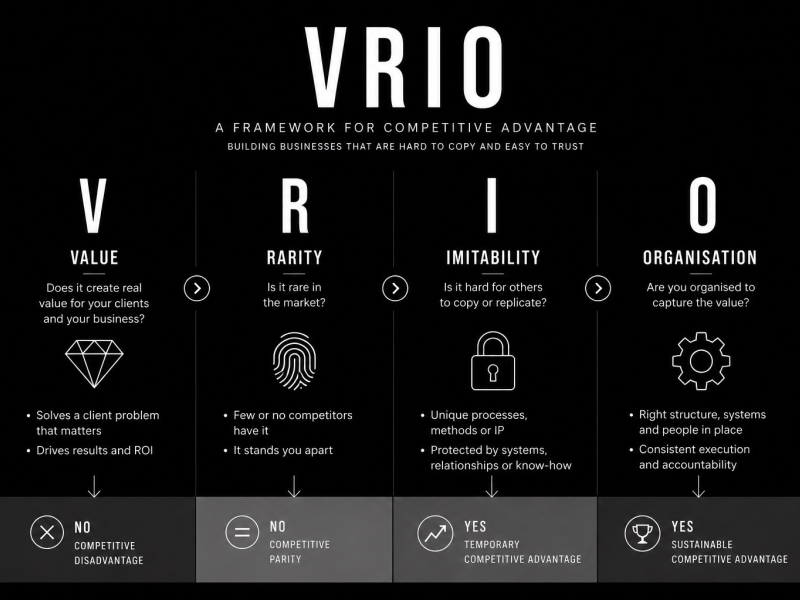
This is where the VRIO model becomes useful. Developed from the resource based view of strategy associated with Jay Barney, VRIO looks at whether a business resource or capability is valuable, rare, costly to imitate and properly organised so it can create sustained competitive advantage. Barney’s earlier work argued that resources need to be valuable, rare, imperfectly imitable and non substitutable to support sustained advantage, with VRIO later becoming a practical way to test that thinking.
What VRIO means inside an estate agency
For an estate agency, VRIO is not an academic exercise. It is a way of looking honestly at what you have, what you do, what you know, who you are connected to, and whether any of it gives a homeowner a stronger reason to choose you instead of the cheaper agent down the road.
Valuable means the resource helps the client achieve something they actually care about. In sales, that usually means more money, better buyers, stronger certainty, less stress, better advice and a process that feels under control. In lettings, it may mean stronger compliance, better tenant quality, reduced risk, less void time and confidence that the asset is being protected.
Rarity means the thing is not easily available from every other agent in your area. Professional photography is valuable, but it is no longer rare. Floorplans, portals, video and 360 tours may support the service but they rarely separate you if every capable competitor can offer the same. The question is not whether the thing is useful. The question is whether it gives you something others cannot credibly claim.
Inimitable means it is hard to copy. A competitor can copy a service list, a strapline, a content style or a valuation script. It is much harder to copy your performance data, your market reputation, your team culture, your client experience, your network, your depth of learning, your local authority, or a proposition that is exclusive to you in your market.
Organised means the business is actually set up to use the advantage. This is where many agents fall short. They may have strong statistics, brilliant people, good systems, a powerful network or a genuine niche, but if the team cannot articulate it, the website does not show it, the valuation pitch does not prove it and the client journey does not reinforce it, the advantage remains trapped inside the business.
The minimum threshold is not your advantage
Every industry has threshold standards. They are the minimum things you must do to be taken seriously by the customer at that moment in time. The problem in estate agency is that many agents are still talking about threshold standards as though they are market leading.
There was a time when good photography felt like a differentiator. There was a time when video gave an agent a visible edge. There was a time when being proactive on social media, building a stronger website or talking about database marketing could separate you from slower competitors. Those things can still matter, but the market has moved, and the client has moved with it.
Today, a seller expects you to present the home properly. They expect photography, floorplans, video, portal exposure, communication, negotiation and advice. They expect you to know what you are doing, and they expect the process to feel professional. These are not unimportant, but they are not enough to justify a higher fee on their own.
If you charge more, you need to prove why paying more creates a better outcome. That proof cannot just be confidence, personality or frustration that the client chose someone cheaper. It has to be articulated through evidence the seller can understand.
Do you actually know your numbers?
This is where a lot of estate agents get exposed. They believe they deliver better results, but they do not always hold the statistics clearly enough to prove it. They feel they are better at protecting value, creating competition, reducing fall through risk or managing the process, but they cannot always show it in a way that changes the seller’s decision.
If you want to command a stronger fee, you need to know the numbers that support your value. What percentage of asking price do you achieve compared with your market? How quickly do you agree sales compared with local averages? What is your fall through rate? How many properties sell after a price reduction? How often do you create competing offers? What is the difference between your original valuation, your achieved price and the final completion figure?
These numbers matter because they move the conversation from opinion to proof. A seller does not just want a cheap agent, they want the best net outcome with the least stress and the strongest confidence that the person handling the move knows how to protect their position.
If you can show that your approach regularly helps clients achieve more money, stronger buyers or fewer problems, your fee becomes easier to understand. If you cannot show that, then the client may see your higher fee as a cost rather than an investment.
Your people may be part of the advantage
VRIO is not only about systems, data and technology. In estate agency, some of the strongest resources sit inside the people who represent the business every day. The character of your team, the judgement of your valuers, the emotional intelligence of your sales progressors, the discipline of your negotiators and the standards set by the owner can all become part of the advantage.
But again, only if they are made visible. Saying you have a great team is not enough, because every agency says that. You need to understand what kind of people thrive inside your business, what kind of clients they serve best, and what kind of experience they create that would be difficult for another agency to replicate.
This connects directly to the market you choose to serve. Who are your customers? Where are they based? What are their ages, lifestyles, property types, purchase sizes, expectations and anxieties? Are they driven by speed, privacy, certainty, presentation, convenience, premium service or price? Do they value brand loyalty, personal advice, local authority, discretion or national reach?
A long term strategy becomes stronger when you stop trying to be equally relevant to everyone. A niche is not a limitation if it helps you become meaningfully valuable to the right part of the market.
The value network matters more than agents realise
Competitive advantage does not always sit inside your four walls. Sometimes it is created by the network around you. In strategy, Adam Brandenburger and Barry Nalebuff developed the Value Net model in their book Co-Opetition, encouraging businesses to look not only at customers, suppliers and competitors, but also at complementors, the people and organisations whose presence makes your offer more valuable.
For estate agents, that matters because no agency grows in isolation. The right network can give you access to better thinking, stronger data, stronger credibility, better partnerships, sharper technology and learning from markets beyond your own. A few friendly agents you speak to occasionally may be useful, but that is not the same as belonging to a structured national network where best practice, performance and market insight are shared with intent.
This is one of the reasons the Leading Estate Agents of the World network matters. It is not just a badge, it is a value network designed to help agents create a stronger proposition in their own market. If you represent your area within that network, and only you can credibly talk about that locally, it gives you something that changes the comparison.
The public can understand the phrase Leading Estate Agents of the World. They can understand performance proof and that being recognised, measured and connected to a wider standard gives them more confidence than an agent simply saying, “we are different.” When the network is backed by performance statistics and a credible public facing platform, the proposition becomes easier to believe.
Technology can become part of the value network
The same thinking applies to technology. A tech stack is not an advantage just because it sounds advanced. Every agent can say they use software, automation, AI or data. The advantage comes when the technology creates something the client can understand and the competitor cannot easily match.
That is why partnerships such as Iceberg Digital matter when they are built into the wider value network. If AI, website infrastructure, data capture, content, search visibility and national level insight are working together, the value is not simply that the agency has another tool. The value is that the agency can be found, understood and supported by a system that helps position it more strongly in the market.
For a local estate agent, that can become powerful if it is exclusive in the area. If only one agency can represent that proposition locally, talk about it in the valuation, connect it to national credibility, and show how it supports the seller’s outcome, it becomes more than technology. It becomes part of the reason the agency sits in a different field of comparison.
The mistake would be to talk about AI as though the letters themselves create trust. They do not. The client cares about what it means for them. Better visibility, better data, better positioning, stronger reach, more informed advice and a clearer route to the right buyer or landlord outcome.
The practical VRIO test for your agency
If you want to use VRIO properly, do not start with your marketing. Start with the business underneath it. List the things you believe make your agency strong, then test each one without ego.
Ask whether it is valuable to the client, not just impressive to you. Ask whether it is rare in your local market, or whether most decent competitors could say the same. Ask whether it would be hard to copy, or whether another agent could reproduce it within a few weeks. Ask whether your business is organised to use it consistently across your team, website, valuation pitch, client experience and follow up.
Do this for your statistics, your people, your niche, your network, your technology, your local reputation, your supplier relationships, your content, your customer data and your client experience. Some of it will be threshold. Some of it will be useful but not rare. Some of it will be promising but underused. A smaller amount may be where your real competitive advantage sits.
That is the work. Not inventing difference, but identifying what is genuinely distinctive and building the agency around it.
The move estate agents need to make
The estate agents who will lead the next stage of the industry will not be the ones still defending old ways of working because “it used to be enough.” The thresholds have moved, and the customer has moved with them. Sellers and landlords are more informed, more exposed to choice, more aware of price, and less willing to accept vague claims without proof.
Your job is to know what is expected, meet it without drama and then move beyond it with evidence. Know your numbers, your niche, your value network and the resources and capabilities that cannot easily be copied. Know how to explain why your fee is not simply higher, but connected to a stronger outcome.
Because competitive advantage is not what you hope the client sees. It is what you can prove, organise and repeat until the market understands it.
Threshold standards get you considered. Distinctive advantage gets you chosen.