Which Generic Strategy Is Your Estate Agency Really Using?
Most estate agents want better fees, stronger profit and a more respected brand, but too many are trying to behave like a differentiator while spending, pricing and positioning themselves like everyone else.

The strategy you choose decides the business you build.
There is a point in every estate agency growth conversation where the subject eventually comes back to fees. Owners want to know how to charge more, how to defend their value, how to stop losing instructions to cheaper agents, and how to make sellers understand that a higher fee is not the same as a higher cost.
That conversation matters, but it often starts in the wrong place. The issue is not just whether you should charge more. The issue is whether your business strategy gives you the right to charge more, and whether the market can clearly see why you are worth it before you sit at the valuation.
This is where generic strategy becomes useful. In simple terms, your generic strategy is the broad route your agency chooses to compete. Are you trying to be the cheapest? Are you trying to stay close enough to everyone else while keeping costs down? Are you trying to match the market but edge ahead in certain areas? Or are you trying to become genuinely different in a way the right clients value enough to pay more for?
Most estate agents never answer that honestly. They say they want to be premium, but they resist the investment required to become premium. They say they want better fees, but their brand, technology, data, marketing, proposition and proof do not separate them strongly enough from cheaper competitors. They say they are different, but the seller cannot feel it, see it or explain it back.
That is not a fee problem. That is a strategy problem.
There are four broad positions estate agents tend to occupy in the market. None of them are accidental. Whether you choose them consciously or drift into them quietly, each one affects your pricing, your costs, your profit potential and the type of client you attract.
The first is the average competitor. This is the agency that operates close to the middle of the market. Average fee, average investment, average proposition, average language, average marketing and average proof. It may still be a good business, but it is highly comparable. The seller does not see enough difference to create a strong preference, so the agency gets judged against familiar alternatives.
The second is the cost leader with proximity. This agency tries to keep costs low while remaining close enough to the expected service level that the customer still considers them credible. They may not be the best, most advanced or most distinctive, but they are acceptable enough for sellers who are more price sensitive and less demanding about depth, brand, evidence or service experience.
The third is the cost leader with priority. This is where the agency competes heavily on price but tries to prioritise certain features the customer values most. It may focus on speed, simplicity, portal exposure or a basic level of marketing that feels enough for a certain type of seller. The danger is that the business must keep costs controlled, because the margin is thinner and there is less room for serious investment.
The fourth is the differentiator. This is the agency that deliberately builds a proposition that the right customers value enough to pay a premium for. It does not rely on being the cheapest. It relies on being more meaningful, more trusted, more proven, more desirable, more capable or more relevant to a particular client group than the alternatives.
This is the place many agents say they want to occupy, but it is also the place that exposes the most contradiction. Differentiation sounds attractive until the owner realises it demands investment, discipline and proof.
You cannot be premium with a cheap business model
Estate agency has a strange relationship with cost. Owners will complain about portals, office costs, technology, staff, marketing, training, branding, data, content and systems, while at the same time wanting to be seen as premium, trusted, modern and worth a higher fee.
There is a tension there that needs naming. If everything in your business is built around free, cheap or the lowest possible option, it becomes much easier for another agent to enter your market and compete at a similar level. There is no barrier. There is no depth. There is no structure that makes you harder to copy.
That matters even more in an industry where entry standards are low. Almost anyone can decide they are an estate agent, build a basic presence, use the portals, offer photography, talk about local knowledge and undercut the market. If your proposition is only built around the same things they can access, you are not protected.
Cheap inputs usually create a cheap comparison.
That does not mean wasting money. It means understanding that if you want to build a differentiated agency, you need to invest in the things that make differentiation real. Better brand work, technology, data, training, content, client experience, better proof, better networks and better people.
A differentiator cannot just look more expensive. It has to be better organised around value.
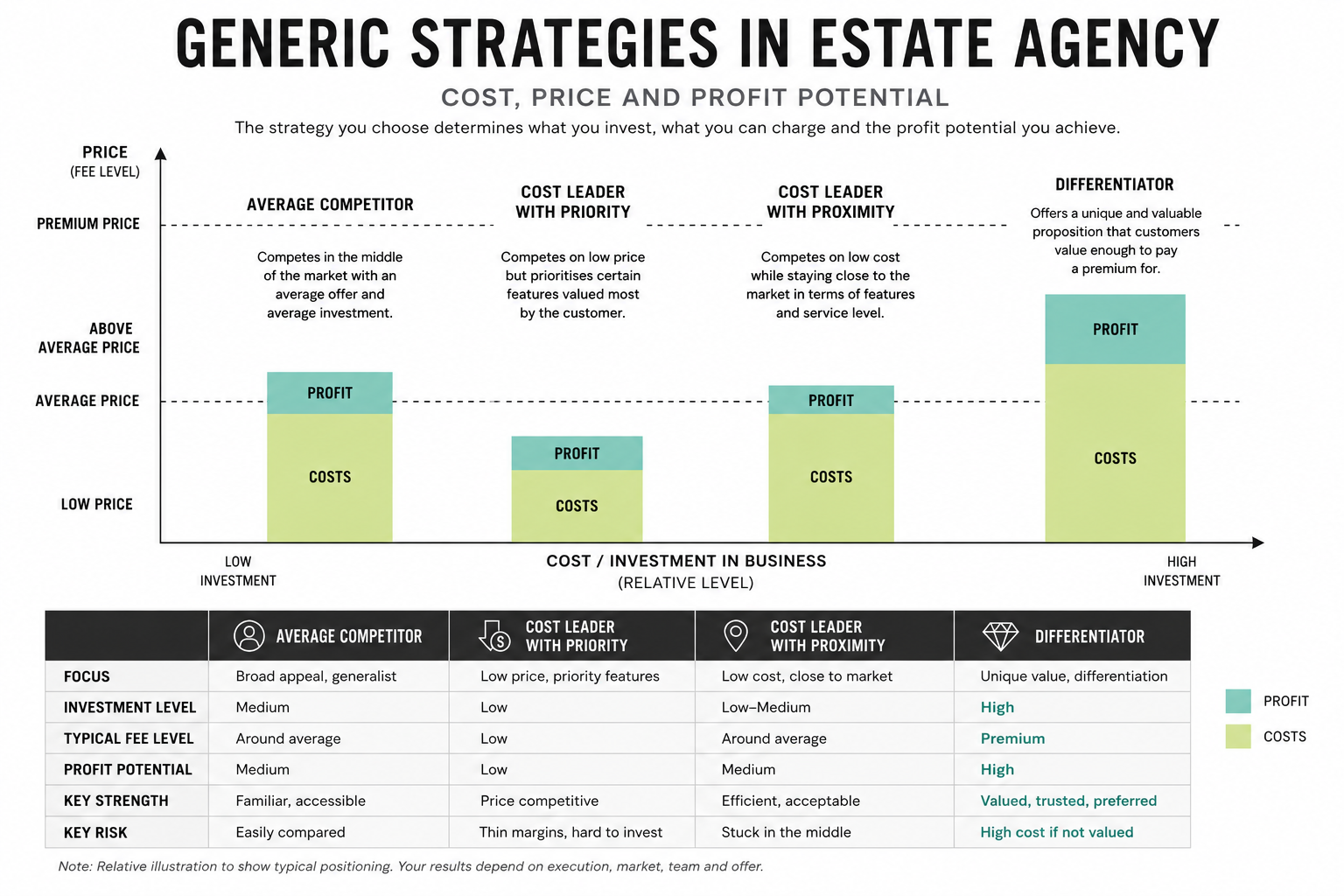
This simple chart showing cost, price and profit across the four strategies. The average competitor sits close to the market norm, spending enough to stay in the game and charging enough to survive, but rarely creating enough distinction to command serious pricing power.
The cost leaders sit lower on cost, but that also limits what they can build. Their model depends on efficiency, volume or simplicity. There is nothing wrong with that if it is deliberate, but it becomes dangerous when an agency tries to compete as a cost leader while talking like a premium differentiator.
The differentiator sits higher on investment, but also has the potential to sit higher on fee, margin and reputation. That does not happen automatically. It only works when the customer values the difference enough to pay for it. Differentiation without customer value is just expensive decoration.
This is where estate agents need to be brutally clear. If your higher fee does not connect to a stronger outcome, a better experience, a more credible proposition or a more valuable result, the seller will see it as cost. But if you can prove that your approach protects value, reduces risk, creates better buyer competition, improves certainty and delivers a better net outcome, the fee conversation changes.
What a real differentiator can talk about
A differentiator does not sit in the valuation and say, “We use professional photography and floorplans.” Those are expected standards. A differentiator explains why its entire approach creates a better result.
That might include performance statistics showing stronger asking price achievement, lower fall through rates, faster sales in a defined price band, better buyer qualification, stronger launch performance, more effective database activation or a better completion record than the local norm.
It might include a unique database, not just a list of contacts, but a properly managed buyer and seller ecosystem with clear segmentation, behaviour tracking and a process that helps match the right people to the right homes before the wider market catches up.
It might include technology that improves visibility, communication, nurture, response speed and data quality. It might include a brand that is easier for the right clients to trust because the language, visuals, proof and experience all feel aligned. It might include better internal systems that mean the service does not rely on memory, mood or individual heroics.
This is why we spend so much time on these areas inside the EAX Business Accelerator. The programme is designed for agency founders, leaders and implementors who want to move from being estate agents who own a business to business owners who run an estate agency, with work across brand, marketing, operations, performance, sales and AI. Used properly, those areas are not separate projects. They are the foundations that allow a differentiated strategy to become visible, repeatable and commercially valuable.
Differentiation has to be built into the business
This is the part agents often underestimate. You do not become a differentiator because you have one stronger marketing line. You become a differentiator when the whole business supports the position you want to hold.
Your brand has to say something clearer than “we care”. Your valuation conversation has to explain why your approach creates a better net result. Your systems have to protect consistency. Your team has to understand the standard. Your data has to prove the claim. Your marketing has to build trust before the appointment. Your technology has to improve the experience, not just give you another subscription to pay for.
The right network can also form part of that wider value stack, but only when it strengthens the client’s understanding of why you are different. For example, Leading Estate Agents of the World is positioned around stronger local authority, sharper public positioning and a better room to grow in, with selected members receiving exclusive area representation, a public member profile, podcast visibility and access to a wider estate agency ecosystem. That can support differentiation because it gives the right agent another layer of credibility, visibility and market positioning, rather than simply another logo to put on a website.
The point is not that joining a network automatically makes an agency premium. It does not. The point is that some assets are harder for competitors to copy when they are connected to exclusivity, performance, public proof, stronger thinking and a clearer client facing story. If only one agent in an area can credibly represent a network, use that positioning in a valuation conversation and connect it to their own standards, service and results, it becomes part of a broader differentiator strategy.
The fee follows the strategy
This is where many agents need to be more honest. You cannot build a differentiated agency and charge like a low cost competitor. You will starve the very things that make the difference possible.
If your strategy requires better people, better marketing, better tech, better proof, better training, better service and better client experience, then your fee has to fund that standard. Otherwise, the business becomes trapped between ambition and affordability. You keep wanting to deliver more, but you have not priced the business in a way that allows more to be delivered sustainably.
That is why fees are not just a sales conversation. They are a strategy conversation and determine what you can invest in, what standards you can protect, what talent you can attract, what marketing you can build, what technology you can use and how much resilience the business has when the market becomes harder.
If you want to be chosen for difference, your pricing has to support the cost of being different.
Look at your agency and decide which strategy you are actually using, not the one you would like to tell people you are using. Are you average, low cost with proximity, low cost with priority, or a true differentiator?
Then ask the harder question. Does your fee match that strategy? Does your investment match it? Does your brand show it? Does your valuation pitch prove it? Does your team understand it? Does the customer feel it before you ask them to pay for it?
The agents who will protect profit in the next stage of the market will not be the ones pretending to be premium while cutting every corner behind the scenes. They will be the ones with the courage to choose a position, fund it properly and prove why it matters.
You cannot charge for difference if you have not built one.