Force Field Analysis for Estate Agents What Is Holding Change Back?
A new idea can make perfect sense and still fail to take hold. Force field analysis helps estate agency leaders see what is pushing a change forward, what is holding it back and where their attention could make the greatest difference.

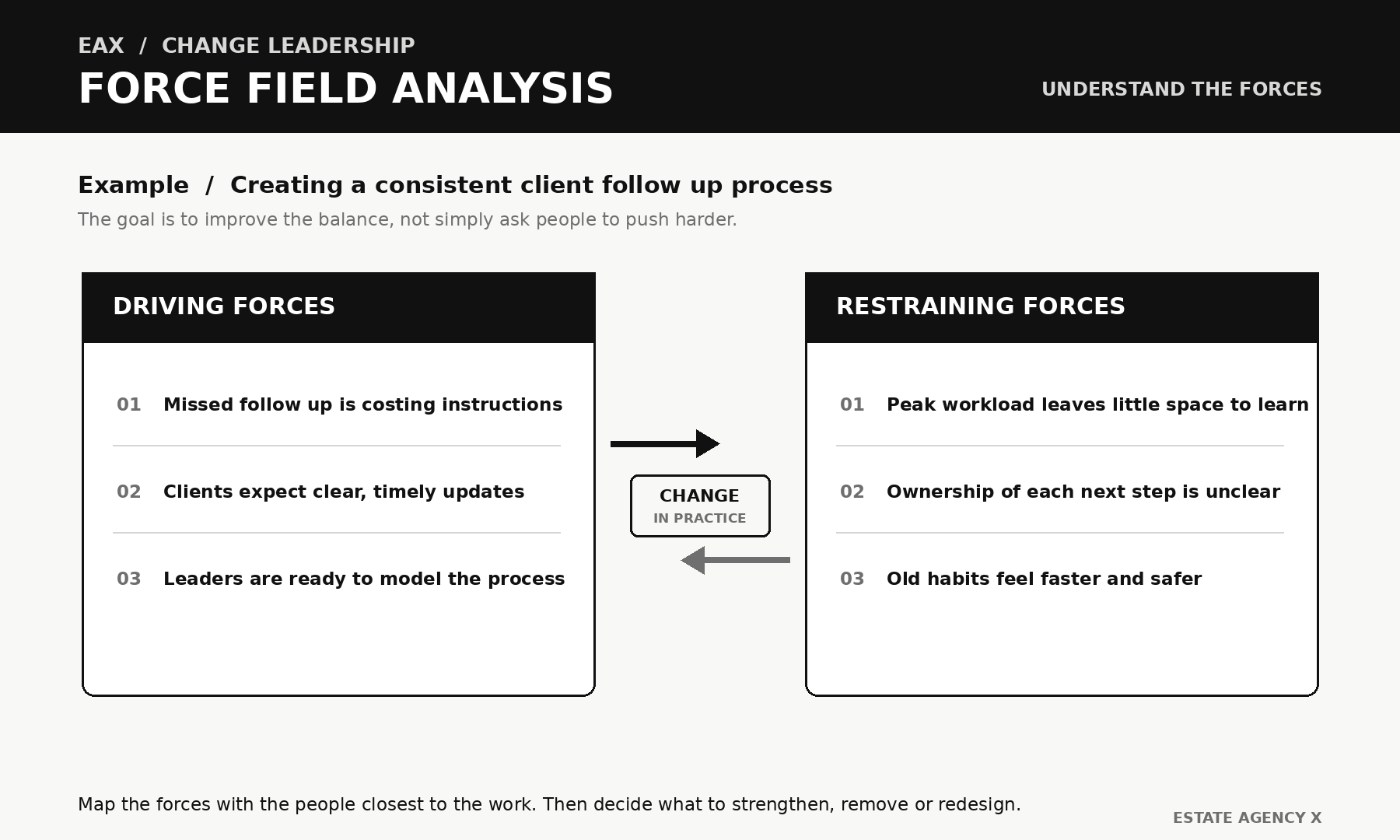
An example of the forces around a more consistent client follow up process.
When the plan makes sense but the team is not moving
Imagine an agency introducing a more consistent process for following up with buyers. Leaders can see the benefits: fewer missed conversations, clearer records and a better experience for clients.
The team may see something different. Negotiators are already moving between calls, viewings and offers. The new process feels like more administration. Some people are unsure who owns the next action. Others worry that the system will be used to monitor them rather than help them.
It is tempting to call this resistance and push harder. Force field analysis gives leaders a better question: what is keeping the current way of working in place?
Developed from Kurt Lewin’s work, force field analysis looks at the factors driving movement towards a desired change and the factors restraining it. The method is used to help organisations understand what is shaping a situation before deciding how to act.
Resistance usually has a reason
People may hesitate because they think they will lose something valuable: confidence, status, control over their work or relationships they rely on. They may have misunderstood what is changing, or they may understand it perfectly and believe the proposed solution will make things worse.
Sometimes the concern is practical. There may be no time to learn a new process, the training may not match the work or the new system may duplicate something the team already does. Sometimes it is more personal. A change that looks minor on a plan, such as moving desks or changing who handles a client, can carry a message about status, trust or belonging.
Those concerns do not automatically mean the change is wrong. They are information leaders need before they can make it work. If people are kept in the dark or asked for feedback that is then ignored, trust can fall and the barriers to change can become stronger.
Map the forces before you choose the solution
Start by describing the change in terms people can recognise. “Improve our service” is too broad. “Every buyer receives a clear update after a viewing” gives the team something specific to examine.
Then map the forces on both sides. What is already helping? What is making the change difficult? In the client follow up example, missed enquiries, client expectations and visible support from managers could all help. Peak workload, unclear ownership and habits built around the old process could hold it back.
Bring in the people who do the work. A manager may see a process problem, while the team can explain where the pressure actually sits. Be willing to hear concerns without treating every objection as a reason to abandon the change.
You can rate each force from one to five to help prioritise the discussion. Use the scores to compare perceptions, not to make the conversation look more scientific than it is. Ask what would need to change for a high barrier to feel less significant.
Reduce friction instead of asking for more effort
Once the forces are visible, choose a practical response. If the team lacks time, protect time to practise the process. If ownership is unclear, agree who takes each next step. If people are worried about monitoring, explain what the information will be used for and make sure managers use it consistently.
Strengthen the forces that are already helping too. Managers can model the new process, early progress can be shared and the people who helped shape the change can support colleagues as they adopt it.
The important distinction is between adding pressure and changing the conditions. Telling people to work harder may briefly increase activity, but it does not resolve confusing ownership or an unrealistic workload. Removing one serious barrier can do more for progress than repeating the vision in another meeting.
Keep revisiting the picture
Force field analysis is a starting point for action, not a one time answer. A team’s confidence can grow as training improves. A new concern can appear when the first client case exposes a gap. Market pressure or staffing changes can shift the balance again.
Research on the method has cautioned that a simple force list can miss the complexity of organisational change. Treat the analysis as a way to open a better conversation, then revisit it as people gain experience and circumstances change.
Before asking how to push a change harder, ask what is holding it in place. The answer may not be a lack of commitment. It may be a barrier leaders can remove, a concern they have not yet understood or a process that needs redesigning. That is where change starts to move.