The Leadership Style Your Estate Agency Team Feels Before It Sees the Results
An agency’s leadership is visible in missed targets, client conversations and the way people respond under pressure. The Blake and Mouton grid gives leaders a simple way to examine how they balance results with the people who deliver them.

The way a leader listens shapes what the team feels able to raise.
Results are visible. Leadership is felt.
A pipeline slips. A client is unhappy. Someone misses target for the third month running. In those moments, a leader’s response does more than deal with the issue in front of them. It shows the team what matters, what is expected and whether people can take responsibility.
That is why leadership style has a direct effect on how an agency works. The target matters, but so does the way the team is led towards it. Push too hard without listening and people may stop speaking up. Focus only on keeping everyone comfortable and standards can drift. Give people no direction and even capable team members can lose momentum.
A grid that brings the tension into view
The Blake and Mouton Managerial Grid looks at two things: concern for production and concern for people. Its five positions help leaders notice where their attention tends to go. Blake and Mouton first set out the model in The Managerial Grid in 1964.
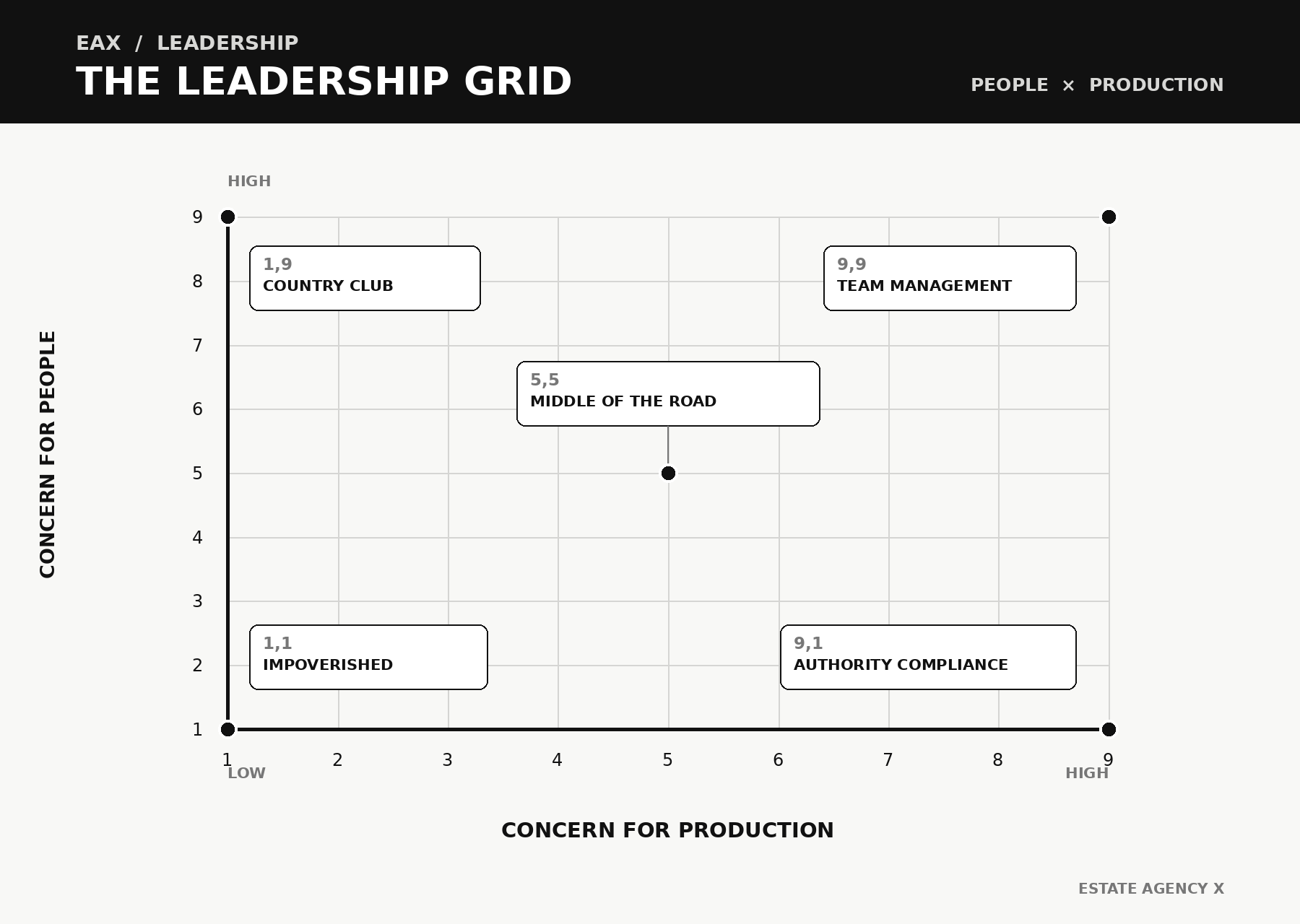
At 1,1, impoverished management, the leader gives little attention to the work or the people doing it. Experienced colleagues may value being left to get on with things, but when low involvement becomes the norm, support disappears with it. Problems can sit unresolved, standards can slip and newer team members may be left to find their own way.
At 1,9, country club management, people receive attention while production takes a back seat. This can help rebuild connection after a difficult period. But if a leader avoids setting expectations or addressing poor performance, the most committed people may end up carrying more than their share.
At 9,1, authority compliance, the work comes first and the leader gives clear direction. That can be exactly what a team needs during an urgent compliance issue or client problem. Used every day, it can make people feel that their judgement is unwanted, leaving them less likely to take initiative or flag risks early.
At 5,5, middle of the road management, the leader tries to keep both people and production in reasonable shape. That can help with routine work where stability matters. When the business needs a step change, however, constant compromise can leave performance and morale stuck in the middle.
At 9,9, team management, the leader holds high standards while involving people in how the work gets done. It can build ownership and improve decisions, especially when a team is redesigning a process or working through a change. It takes time, though. When an urgent decision is needed, consultation must not prevent someone from taking responsibility.
The grid is most useful when it helps a leader notice their default setting. It does not make the decision for them. The people, the work and the moment still matter.
Your style is shaped by more than personality
Leadership theories offer several ways to understand what is happening. Trait theories look at qualities such as integrity, empathy and assertiveness. Behavioural theories focus on what a leader does: direct, consult, delegate or coach. Contingency theories consider how the task, the team and the environment affect which approach is likely to work. Power and influence theories ask how leaders use their position, expertise, relationships and authority.
Kurt Lewin’s familiar styles make those behavioural choices easy to recognise. An autocratic leader makes the decision without team input, which can be useful when time is short. A democratic leader invites views before deciding, which can build commitment and surface better ideas. A laissez faire leader gives people more freedom, which can work well with a capable, self managing team. Each style has a place. Each can create problems when it is the only response a leader uses.
Other models add further options. Path Goal Theory considers what people need to make progress. Fiedler’s Contingency Model looks at the fit between leadership and the situation. Goleman’s six emotional styles include visionary, coaching, affiliative, democratic, pacesetting and commanding approaches.
Transformational leadership can help a team connect its daily work to a shared purpose. Servant leadership puts the team’s needs at the centre. Transactional leadership clarifies responsibilities and rewards. Bureaucratic leadership protects consistency where procedures matter. Charismatic leadership can energise people, while also carrying a risk if the leader’s own ambition becomes more important than the team.
Coaching gives people space to think while keeping expectations clear.
The cost builds when the mismatch becomes a habit
One poor leadership decision does not define a team. The cost builds when leaders keep using an approach that does not fit the situation.
People who are rarely heard may stop offering ideas or raising concerns. People who are never challenged may lose clarity about what good performance looks like. People left without support may make avoidable mistakes. Over time, that can mean inconsistent service, missed opportunities, complaints, staff turnover and damage to an agency’s reputation.
A meta analysis by Schyns and Schilling found that destructive leadership was associated with poorer employee attitudes and wellbeing, lower performance, resistance and greater intention to leave. That research concerns harmful leadership behaviours, rather than the grid positions themselves, but it underlines the wider cost of leadership that repeatedly gets in the way of people doing good work.
Choose the response the moment needs
Before your next difficult conversation or decision, pause and ask: how urgent is this, what does this person need from me, and would involving the team improve the outcome?
Then pay attention to what happens next. Do people understand what is expected? Can they raise a concern? Are they taking more responsibility, or waiting for you to decide everything?
Strong leadership is not about staying in one position on a grid. It is about keeping your standards clear, understanding the effect your behaviour has on others and adapting your approach so the team can deliver well and keep growing.