
Why Estate Agents Should Understand The Balanced Scorecard
Most estate agents have numbers, but not always a clear view of performance. The Balanced Scorecard helps agency owners connect vision, people, process, customers and profit so the business is not judged by one monthly figure alone.

Most estate agents are measuring something, but not always the right things together
Estate agency has never been short of numbers. Most owners can tell you how many valuations are booked, how many listings have been won, how many sales have been agreed, what the pipeline looks like and where the month is likely to land. The dashboard might be busy, the reports might be regular and the conversations might sound commercial, but that does not always mean the business is being measured properly.
The issue is rarely the absence of data. The issue is that the data often sits in separate places, with no clear connection between the long term direction of the business and the daily behaviours that create the results. One meeting looks at fees. Another looks at pipeline. Another looks at marketing. Another looks at staff. Another looks at service. Everything matters, but the owner is left trying to hold the whole picture together in their head.
That is where the Balanced Scorecard becomes useful. It gives estate agency owners a more complete way to look at performance, because it does not allow the business to be judged by financial results alone. It asks whether the agency is growing profitably, whether clients are becoming more loyal, whether the internal processes are strong enough and whether the people inside the business are improving.
For an estate agency, that is important because profit is not created by finance. Profit is created by reputation, standards, process, leadership, client trust, team capability and the ability to turn good work into repeatable performance. If you only look at the financial result at the end of the month, you are often looking too late.
Where the Balanced Scorecard came from
The Balanced Scorecard was introduced by Robert Kaplan and David Norton in the early 1990s. Their original work appeared in Harvard Business Review in 1992 and came out of research into how companies could measure performance more effectively, especially at a time when businesses were realising that financial measures alone did not explain enough about future success.
The principle was simple, but powerful. A business should not only ask what happened financially. It should also ask what customers are experiencing, which internal processes need to improve and whether the people, systems and skills inside the business are developing in the right direction. Kaplan and Norton later described the Balanced Scorecard as a way to connect strategy with the measures and actions that drive it, rather than leaving strategy as something written down and forgotten.
That is the part estate agency owners should pay attention to. Strategy often fails not because the idea was wrong, but because it never gets translated into how the business is actually run. The Balanced Scorecard gives the strategy somewhere to land.
It may sound like something from a large corporate boardroom, but its use has been much wider than that. A 30 year review of the Balanced Scorecard noted that it became one of the most influential performance measurement and strategy tools in modern business. It has been used by serious organisations because it solves a real leadership problem. Businesses need a way to stop performance becoming a narrow conversation about financial outcomes and start connecting results to the people, processes and customer experience that create them.
Tesco is a useful example. Tesco developed its own version of the Balanced Scorecard, known as the Tesco Steering Wheel. The idea was to help the business look at performance from more than one angle, connecting bigger business targets to the work people were doing day to day. You do not need to copy Tesco. That would be ridiculous but the lesson is still relevant. Strong businesses find a way to make performance visible, shared and connected. They make sure people understand what matters, how success is measured and how their role contributes to the direction of the business.
The four areas every estate agency should be looking at
The Balanced Scorecard looks at the business through four perspectives: financial, customer, internal process and learning and growth. For estate agency, that gives owners a much better way of seeing the business as a system rather than a collection of disconnected numbers.
The financial perspective asks whether the agency is growing in the right way. That might include total fee income, average fee, net profit margin, recurring lettings income, revenue per employee, cost control and the balance between sales and lettings. These measures matter because the business has to make money, but they only show the outcome of other work.
The customer perspective asks how clients see the agency. That means vendors, buyers, landlords and tenants. It might include review scores, referrals, Net Promoter Score, landlord retention, repeat instructions and the share of new instructions in core postcodes. This is where brand becomes more than how the business looks, because reputation is one of the strongest commercial assets an agency has.
The internal process perspective asks what the business must do well. In estate agency, that might mean valuation to instruction conversion, fall through rate, sale agreed to completion time, compliance, same day follow up, sales progression, buyer qualification, material information and the consistency of the client journey. These are the moving parts that often decide whether good activity becomes profitable performance.
The learning and growth perspective asks whether the people and systems inside the business are getting stronger. This might include staff engagement, qualifications, training, retention, CRM use, lead response times, AI adoption and whether the team has the tools and confidence to do the job properly. It is often the area that gets ignored until something breaks, but it is usually where future performance is being built or weakened.
What this looks like inside your estate agency
This is where the Balanced Scorecard starts to become useful, because it takes something that can sound very theoretical and turns it into the way you actually look at your agency. Let’s say your vision is to become the most recommended estate agent in your patch. That sounds good, but on its own it is not enough. It is too easy to say. The harder question is what would need to be true inside your business for that to happen.
You would need the financial part of the business to be healthy. That might mean growing total fee income, protecting your average fee, increasing recurring lettings revenue and improving net profit margin. You would need to know whether the business is becoming stronger commercially, not just busier.
You would need your customer experience to be improving. That might mean better reviews, more referrals, stronger landlord retention, more repeat clients and a higher Net Promoter Score at completion. If you want to be recommended, you need to measure whether people are actually having an experience worth recommending.
You would need your internal processes to be working properly. That might mean improving valuation to instruction conversion, reducing fall throughs, shortening the time from sale agreed to completion and staying fully compliant across managed lettings. These are the parts of the business clients may not always see, but they absolutely feel when they go wrong.
You would also need your people and systems to be getting stronger. That might mean better staff engagement, fewer leavers, more training, faster lead response times, stronger CRM use and better use of technology. This is often the area owners look at last, but it is usually where the future performance of the business is either being built or quietly weakened.
That is why the Balanced Scorecard works. It forces you to stop looking at one number in isolation and start asking whether the whole business is aligned behind the strategy you say you want.
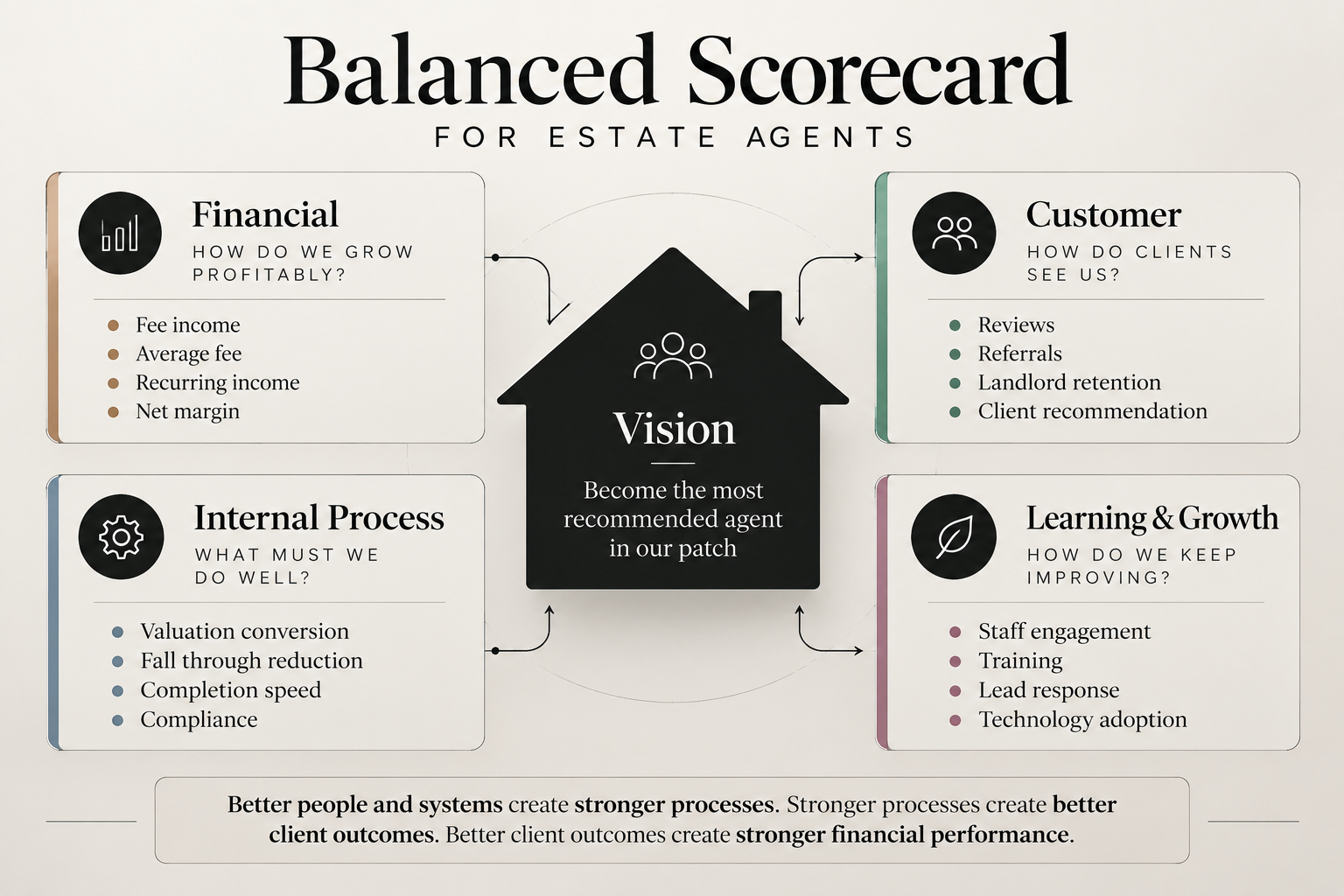
The scorecard should connect your vision to the work
A good scorecard does not just sit in a document. It should help you see the connection between where the agency is going and what the team is doing. If your vision is to become the most recommended agent in your patch, then every part of the scorecard should point back to that. Your financial measures should show whether the business is growing in a way that gives you strength. Your customer measures should show whether clients are becoming more loyal and more likely to recommend you. Your internal process measures should show whether the experience is consistent. Your learning and growth measures should show whether your team, systems and capability are improving.
That is the bit many agency owners miss. They set the vision at the top, but then measure the business underneath it in a completely disconnected way. They talk about reputation, but only review listings. They talk about service, but do not measure client experience properly. They talk about growth, but do not measure whether the team has the skills, confidence or systems to support it.
The Balanced Scorecard gives you a way to connect those things.
It makes the strategy visible.
It makes the priorities clearer.
It makes performance less dependent on what the owner happens to be worrying about that week.
The real power is in cause and effect
The strongest way to read a Balanced Scorecard is not from the financial number down. It is from the foundations up.
Better people and better systems create stronger processes. Stronger processes create better client outcomes. Better client outcomes create stronger financial performance.
That sounds simple, but it changes the way you lead.
If your fee income is not where it needs to be, the answer may not be to shout harder about fees. It may be that your valuers are not confident enough in the pitch, your positioning is not strong enough, your follow up is too weak, your proof is not clear enough or your team is not being coached properly.
If your fall through rate is too high, the answer may not be to blame the market. It may be that buyer qualification needs tightening, funds checks need to happen earlier, sales progression needs more ownership or the process from offer to completion is not strong enough.
If landlord retention is weaker than it should be, the answer may not be another email campaign. It may be that landlords do not feel properly reviewed, advised or looked after once they are already inside the business.
The numbers at the top rarely move properly until the foundations underneath change. That is why this framework is useful. It stops you asking only, “why is the number not better?” and pushes you to ask, “what needs to improve inside the business for that number to become better and stay better?”
Keep it simple or it becomes another thing you never use
The danger with any framework is that it becomes too complicated. Estate agency owners do not need another management document that gets created once, saved somewhere and never looked at again. You need something sharp enough to use and simple enough to keep alive.
A good estate agency scorecard does not need fifty measures. Sixteen is more than enough. Four financial measures. Four customer measures. Four internal process measures. Four learning and growth measures.
That discipline matters because if you measure everything, nothing stands out. The point is not to track every number available to you. The point is to choose the measures that tell you whether the business is moving towards the strategy you actually care about.
Each measure needs a baseline. Where are you now?
Each measure needs a target. Where do you want to get to?
Each measure needs an initiative. What are you going to do to move it?
Each measure needs an owner. Who is responsible for making sure it does not disappear into good intentions?
Without ownership, the scorecard becomes observation rather than leadership.
How to use it without overcomplicating it
Start with your vision. Not the vague line that sounds good on the website, but the real direction of the business.
Do you want to become the most recommended agent in your area? Do you want to protect your fee levels? Do you want to grow the lettings book so the business has more recurring income? Do you want to reduce fall throughs? Do you want to improve profit per person? Do you want to build a team that performs without every decision running through you?
Once you know that, choose the measures that prove whether you are moving in the right direction.
For the financial perspective, you might track fee income, average fee, recurring income and net margin.
For the customer perspective, you might track reviews, referrals, landlord retention and client recommendation.
For the internal process perspective, you might track valuation conversion, fall throughs, completion speed and compliance.
For the learning and growth perspective, you might track staff engagement, training, lead response and technology adoption.
Then review it properly. Not as another meeting for the sake of it, but as part of your leadership rhythm. Some measures need monthly attention, especially pipeline, conversion, fall throughs and lead response. Some measures can be reviewed quarterly, such as reviews, referrals and client feedback.
The point is not to create more admin. The point is to stop the important things being ignored until they become expensive problems. The question is whether your measures match your strategy This is where the Balanced Scorecard becomes uncomfortable in the right way.
If you say client experience matters, are you measuring it properly?
If you say your people are your strength, are you measuring engagement, training and retention?
If you say profit matters, are you measuring margin, average fee and revenue per person, not just turnover?
If you say you want more quality instructions, are you measuring conversion, fee holding, market share and the type of clients you are attracting?
If you say technology is going to improve the business, are you measuring whether it is actually improving speed, consistency and decision making?
Most agencies are measuring something. The question is whether they are measuring the things that connect to the business they say they are trying to build. That is why the Balanced Scorecard is worth understanding. It gives you a clearer way to see the whole agency, not just the loudest part of it. It helps you connect vision to behaviour, behaviour to process, process to customer experience and customer experience to financial performance.
The agencies that perform consistently will not be the ones staring harder at the end of month figure. They will be the ones that understand what is driving it.